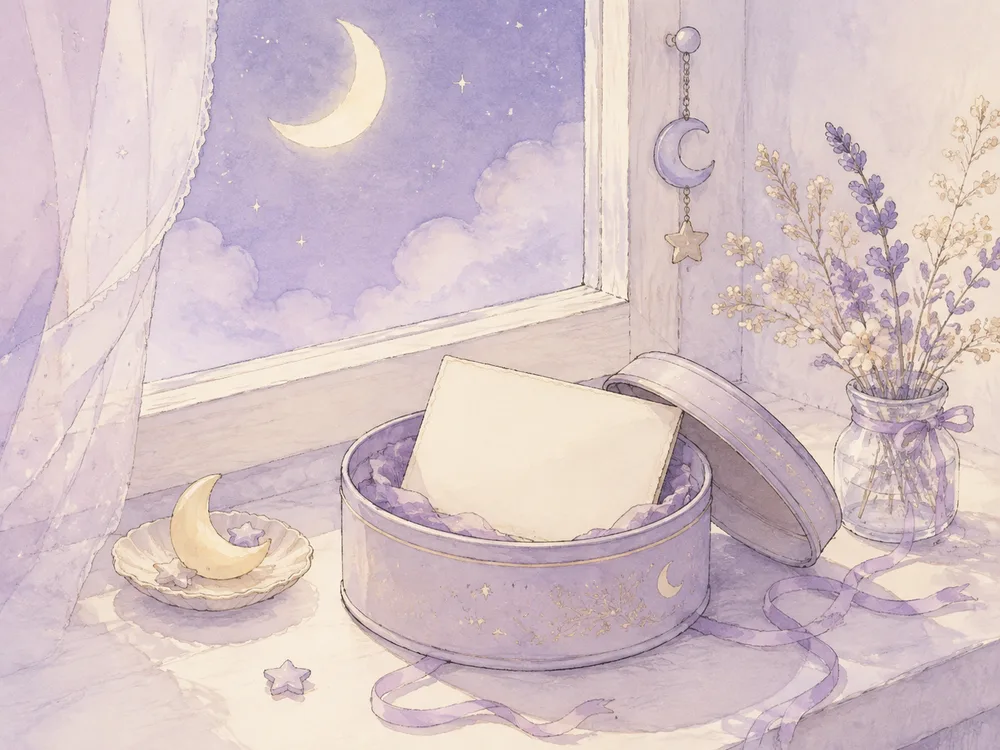
The letter goes into the box; the words don't disappear
The small box sits by the window, lid not quite closed. Holding off isn't giving up — sometimes it's because you have too much to say, sometimes it's because you don't yet know how you want them to answer. Keeping an unsent letter isn't weakness. It's still being sorted out.
Write two versions today
Pick something you want to work through, but that isn't urgent. First write the most unguarded version — don't edit anything. Then write a second version with just the facts and what you need. Put them side by side: which line is the one that most wants to be understood? Often it's in the first version — and the first version is the one that never gets sent.
A draft is allowed to contradict itself
When you're writing for yourself, a sentence doesn't have to make sense to everyone. You can want to get closer and want to rest, both at once. You can feel it's a shame and also know you don't want a do-over. A real letter can't say both at the same time; a draft can. That's exactly what it's for — writing both down lets you actually see what you're weighing, instead of just feeling like a mess inside.
Not sending it doesn't mean it can only go to that person
Some things aren't really meant for the person you thought they were for. Write it to a friend who won't repeat it, to yourself five years ago, to a page with no one's name on it — once it's out of your head, it gets easier to handle. The version in your head loops on its own, ten times a day. The version on paper just sits there, waiting for you to come back to it. Once it's written, fold up the page — that counts as finishing something too.
Still, putting it away isn't the same as dealing with it
If there's a deadline, or someone's genuinely waiting on a necessary answer, tucking the letter in a drawer is just postponing it. You can reply to the part you're sure of now, and say the rest needs a little more time. Holding off is for you — it's not something the other person should have to wait on.
Open it again in three days
Set a time to come back to the draft — three days, a week, whatever — put it on your calendar, don't rely on remembering. When it does come back to mind, it's usually at 1am, and that's not a good time to reread anything.
When you reread it, the question isn't whether you're brave enough to send it
Ask these three things: do I still want to say the same thing now? Are they the right person to hear it? Is what I need from a reply actually clear? If the honest answer is that it was only ever meant for you, that's a complete way to handle it too — you don't owe anyone an explanation. The urgent sentence from three days ago often stops mattering on its own by the fourth day.
This result is an original story and everyday prompt generated from your picture choices — not a psychological assessment, a fixed personality judgment, or a prediction about the future. This public result page describes one story; it does not mean the reader has taken the quiz.