Result profile
The Drizzle Type
It never gets loud, but it stays with you the whole day
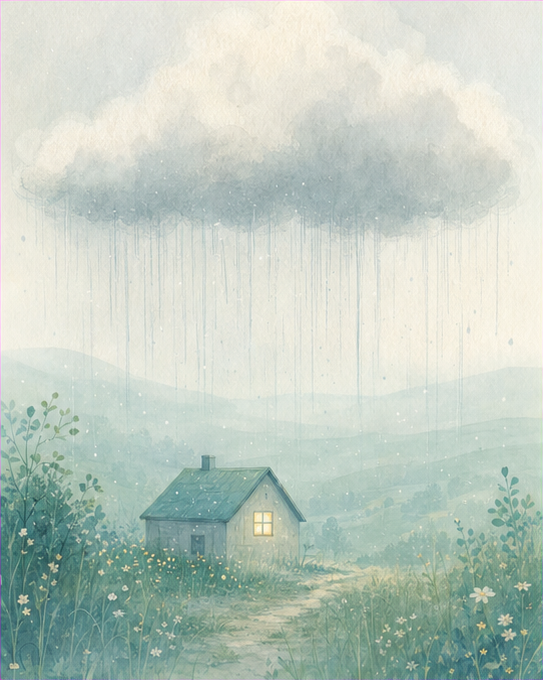
You don't need a downpour before you admit you're already wet.
- Quietly persistent
- Slow to clear
- Easy to miss
- Needs a small opening
Result profile
It never gets loud, but it stays with you the whole day
You don't need a downpour before you admit you're already wet.
On the way home you can still pick up dinner, answer a text, laugh a little. Then you get to the drink fridge at the convenience store and suddenly can't decide what to grab. Nothing dramatic happened, but that one uncomfortable line has been following you the whole way. Based on this answer, your feelings work more like drizzle: you notice them right away, the intensity isn't necessarily high, but they don't clear quickly either.
Being able to go about your day doesn't mean the feeling has been dealt with. People around you see you still chatting and assume that small moment earlier is already behind you. You might also hold off saying anything yourself, because it doesn't feel "serious enough." So no one is deliberately ignoring you, and yet that thing never quite finds a place to be said out loud. Drizzle tends to build up hidden inside these moments that look, from the outside, perfectly fine.
Noticing you're a little upset, and letting someone else know, are two different steps. This result doesn't mean you're bad at expressing yourself, and it doesn't mean you're especially sensitive or especially good at looking after others. It just points out that what you picked tends to sit at low intensity for a long time. Pay attention to whether that heaviness fades on its own, or comes back every time something related happens. If it's the second one, there's probably a specific need that hasn't made it into the conversation yet.
You don't need to start from your whole life or your whole week. Pick one moment first: "Earlier, when the topic got changed mid-sentence, that stung a bit." Then say what you'd like right now, maybe to finish what you were saying, or to have someone sit with you for a bit. If you're not ready to talk to anyone, just write down what happened and how it felt, without pushing yourself to fully understand it yet.
"It's not a big deal, but this has been on my mind all day, and I want to bring it up again." A small feeling deserves a small opening too, it doesn't have to build into a downpour before it's worth hearing. Weather changes with the situation and the relationship; next time you speak up earlier, notice if that heaviness feels any different. What you're tracking is your own rhythm, not trying to live up to a label.
This quiz is for entertainment and self-reflection only, not a psychological diagnosis.
EXPLORE / 05
Every outcome has a story. Explore another perspective and see what resonates.
Currently reading The Drizzle Type
Browsing opens result articles. It does not retake the quiz or recalculate a score.