Result profile
The Gentle Note Left by the Door
Say the care specifically — the reply can take its time.
Say the care specifically — the reply can take its time.
- Specific care
- No hidden test in the gesture
- Room to reply in their own time
Result profile
Say the care specifically — the reply can take its time.
Say the care specifically — the reply can take its time.
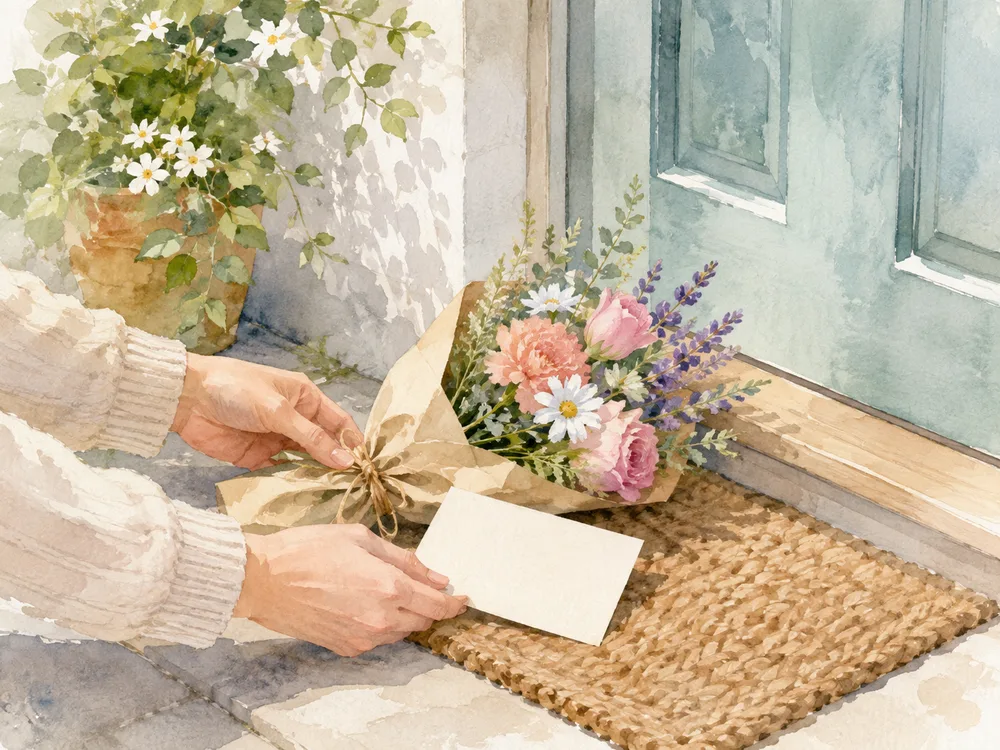
Soft flowers left by the door, and the card doesn't say "you have to be happy" — it says something you actually remember. Your picture choices sent this soft expression toward a friend, and that's where the story starts. If you want to look out for someone today, what do you most want them to know? A simple "I was thinking of you" can be light. But if there's something you actually want to talk about, you don't have to bury it inside the bouquet and hope they figure it out.
"Hope you're doing well" is nice, and it can carry more with one real detail added: "I still remember you waiting with me for the bus that time." A specific small thing gives the bouquet its own origin — not a pretty line that could be sent to anyone. If you just want to say hi, you can say exactly that, without pretending they must be going through something, or that you need to solve a problem for them.
After you send a feeling, the other person might be genuinely moved, or might just say a quick thanks — neither reaction necessarily says anything about how close you are. Let them receive it in their own way, without asking whether they took a photo, where they put it, or why they didn't reply more. Gentleness isn't only the color of the flowers; it also means not dictating how someone else should show they were touched.
Sometimes trying to say something lightly ends up hiding what you actually mean. If you want to say thank you, say thank you. If you want to find time to meet, ask clearly. Flowers can accompany the conversation, but they shouldn't have to carry the whole script. Check first, too, whether this person actually likes receiving this kind of gift and whether it's a good time — let the gesture fit their life, not just the surprise you pictured.
Write three lines on paper: one thing you remember, the feeling you want to express, and space for them to not reply right away. For example: "That day you helped me sort things out, I was really grateful. Just wanted you to know — no rush." Decide whether to send it after you've written it. You don't need real flowers; sometimes just putting the feeling into words already makes the next conversation easier.
Read the card once and check whether there's an unwritten task hiding inside it — needing them to reply right away, needing them to prove they liked it, needing them to guess what you're really asking. If there is, decide whether to say it directly or leave it in your draft for now. You don't have to erase every expectation, just don't let a piece of care double as a test. What this bouquet is meant to offer is something they can actually receive, and something you don't have to keep guessing about — the blank space by the door can stay genuinely blank.
This is an original story and set of everyday questions built from your picture choices, for entertainment and self-reflection only — not a psychological diagnosis, a fixed personality judgment, or a prediction.
EXPLORE / 04
Every outcome has a story. Explore another perspective and see what resonates.
Currently reading The Gentle Note Left by the Door
Browsing opens result articles. It does not retake the quiz or recalculate a score.