Result profile
Pudding by the Window
Just sit down — rest doesn't need a result of its own.
Just sit down — rest doesn't need a result of its own.
- unproductive downtime
- a table for one
- rest with no add-ons
Result profile
Just sit down — rest doesn't need a result of its own.
Just sit down — rest doesn't need a result of its own.
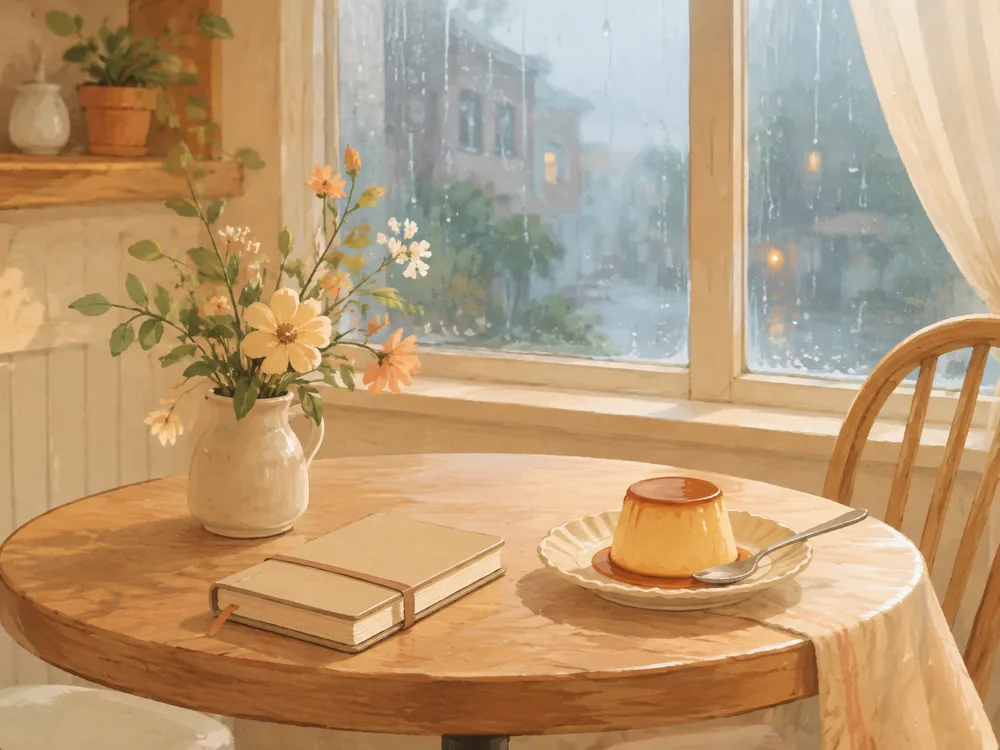
Raindrops slide down the glass, the spoon rests against the edge of the plate, and for now this table is just for one. Your picture choices put being alone and making nothing side by side, so the story starts by asking: if you didn't have to make use of the time, how would you want the next ten minutes to pass? Don't read this as not liking people. Sometimes it's just that even rest keeps getting asked what it's for, and that's exactly why you want a stretch of time that doesn't owe anyone an answer.
A table for one has its own very practical comforts: you choose the sweetness yourself, you can stop reading wherever the page falls, you don't even have to explain why you're staring into space. In everyday life this might look like sitting for ten minutes after work before you open your own front door. That stretch isn't a rejection of the people who matter to you — it's giving your attention room to come back slowly from everything that's been asking for it outside.
Rest sometimes gets dressed up as if it needs scented candles, a pretty cup, and a book you can actually follow. Pudding by the window doesn't actually care where it happens. Hot tea from a convenience store, a chair at home that isn't buried under things — either one holds the same moment just fine. Letting your body settle and actually tasting what's in your mouth gets you closer to what this story card is really about than making the photo look like a vacation does.
Still, quiet without any edges can let a reply someone's actually waiting on sit untouched too long. If someone is waiting for a firm plan, give them one clear time first, then set the phone down. You don't owe an apology for resting, but you can let people know when they'll be able to reach you. Leaving a door you can open later usually holds up better than forcing yourself to stay reachable all the time.
Find a gap you'd have had free anyway, and give it one very small thing: finish half a cup of tea, or listen to one song all the way through without skipping. Before you start, decide only when you'll go back to what you were doing — don't set a mood-improvement goal for the time in between. If your mind wanders partway through, you don't need to restart the clock; noticing and coming back to the present is already the care you meant to give yourself.
When you leave, don't ask yourself whether you're fully recharged — just ask what made things a little lighter a moment ago. Was it the phone staying quiet, no one needing you to respond, or knowing this stretch of time didn't have to produce anything? Next time, start from whichever one it was; a convenience store or a chair at home works just as well. This pudding table isn't asking you to be alone every day, and it isn't scoring quiet time higher than company — it's just here to help you notice what kind of gap is actually meant for you.
This is an original story and everyday prompt generated from your picture choices, not a psychological assessment, a fixed personality judgment, or a prediction. A public results page shows one possible story and doesn't mean that reader actually took the quiz.
EXPLORE / 04
Every outcome has a story. Explore another perspective and see what resonates.
Currently reading Pudding by the Window
Browsing opens result articles. It does not retake the quiz or recalculate a score.