Result profile
The Seed Drawer Garden
Make starting easy, and keep stopping part of the plan too.
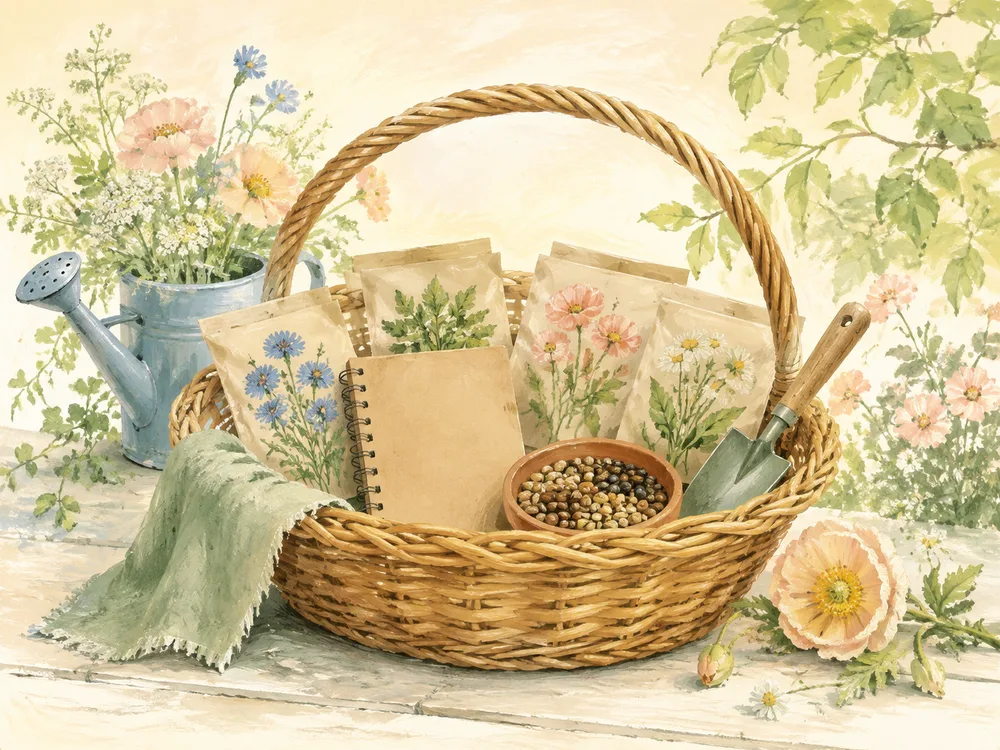
Make starting easy, and keep stopping part of the plan too.
- Own hands-on time
- Less guesswork in the order
- Says the scope up front
Result profile
Make starting easy, and keep stopping part of the plan too.
Make starting easy, and keep stopping part of the plan too.
The seeds are sorted by season, the gloves are in their usual spot, and only what's needed today is out on the table. This version puts working with your hands, being on your own, and having a plan beforehand all together — you don't have to wait for anyone else to be free before you can do the thing in front of you. It wants you to notice: is a clear order helping you start, or is it quietly turning into more and more prep, while the thing you actually wanted to do keeps getting pushed back?
Keeping the things you use most in the same place cuts down on hunting around and on re-deciding every time. Whether that's actually useful is a question of whether it's convenient in practice — a nicely sorted drawer isn't the same as being able to reach what you need. Start with your three most-used items and find the rest as you go. The point of organizing is to support the work in front of you, not to hand you a new daily chore of keeping a tidy drawer.
If you get stuck on a step you don't know, wanting to finish it yourself doesn't mean asking for help is off the table. Saying what you've already tried and exactly where you're stuck usually gets you a more useful answer than "I don't know how to do this." You can still decide the next move yourself after hearing it — taking in information isn't the same as handing over the whole task. Solitude here is a way of arranging time, not a rule that you have to handle every problem alone.
Sometimes you meant to do just one pot, saw the one next to it wasn't tidy either, and kept going. If the point today was to keep one comfortable stretch of hands-on time, you can pick a stopping marker ahead of time, instead of waiting until there's genuinely nothing left to do. Putting the tools away and writing one line about where to pick up next time is enough to hold your progress. Not finishing the whole garden doesn't mean this stretch of time had no value, and rest doesn't need to be paid for with overtime.
Pick something already half-done, or a small task you have, and only do the part you actually have time for. Before you stop, write the next step as one sentence you could act on right away — which material to pull out first, which spot to check first. Don't stack five follow-up tasks onto it, and don't reorganize all your supplies. Next time, try that one sentence and see if it actually saves you effort; if it doesn't, rewrite it closer to wherever you actually got stuck.
Put today's tools away — you don't have to open every packet of seeds you haven't used yet. Think about what actually helped: a clear order, materials that were easy to find, or time nobody interrupted? Those can be arranged separately — none of them require a more complete list to work. This story borrows a seed drawer to help you find what actually supports you working with your hands; a plan can be reliable and still leave room for a sudden break, and for the version of you that wants to try it differently next time.
This is a small story pieced together from the pictures you picked. It's not a psychological test and has no diagnostic or predictive power — treat it as a bit of fun self-observation.
EXPLORE / 08
Every outcome has a story. Explore another perspective and see what resonates.
Currently reading The Seed Drawer Garden
Browsing opens result articles. It does not retake the quiz or recalculate a score.