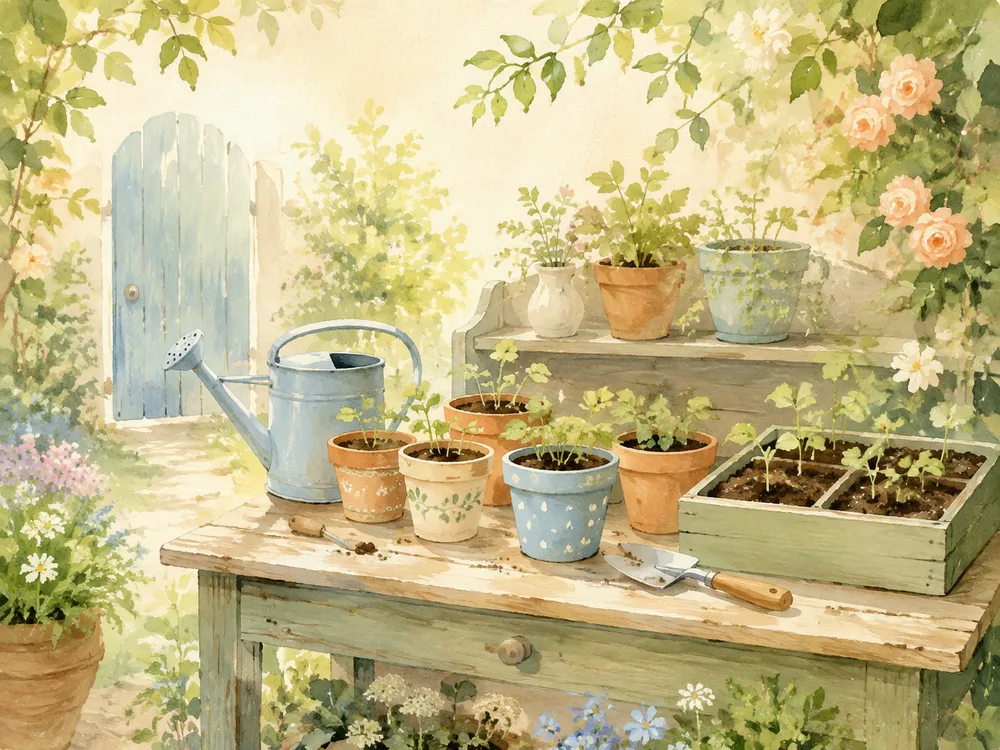
Four pots on the table, and today you're only using one
There are empty pots on the table, but you only bring a small handful of materials in front of you. This version puts working with your hands, being on your own, and adjusting as you go all together — you don't have to picture the finished result before you start. It asks: if all you're doing today is finding out whether you like this, what's the smallest way to try it? Picking a picture can't prove you have follow-through or talent, but it can borrow this small scene to let an idea you've been sitting on touch something real.
The answer doesn't always show up in your head first
Once you've handled the materials and tried a stretch of it, you might find out where it differs from what you imagined. Treat those differences as information, not an instant verdict on whether this is for you. If it turns out what you actually enjoy is picking and arranging, not the long stretch of making, you can adjust based on that. The point of trying isn't to force an interest into a skill — it's to give you a clear enough feeling to decide whether to keep going, switch to something else, or stop here for now.
Figuring it out yourself doesn't mean skipping the instructions
Keeping things flexible still means knowing the basic limits, especially with materials or tools you're not used to. Learning the right way to use something first, then trying it within that, saves more effort than guessing over and over. Not sharing the process with anyone doesn't stop you from asking one specific question. The solitude in this story is just letting you explore at your own pace — it's not asking you to prove anything single-handedly, or to compare your speed to anyone else's results.
New tools can push the actual start further away
Just getting interested in something can send you straight to browsing accessories and collecting tutorials, and the time for actually doing it never quite arrives. If you've already put a lot of effort into preparing, ask yourself: can what I already have make the simplest possible version? If the answer's yes, hold off on buying anything new for now. Fewer materials the first time actually makes it easier to tell whether what draws you in is the process, or the idea of owning a complete set of tools — both are worth seeing clearly.
Today, just note one thing you only learned by trying
Pick something small you already wanted to do, and make a short version of it with whatever's on hand. At the end, write just one line: "turns out this part wasn't what I expected." You don't need to score the whole experience. If you want to keep going, note what to change next; if you don't, just put the materials away. Don't let today's curiosity swell into an ongoing commitment — leaving room to change your mind makes it easier to actually start again next time.
No rush to fill the empty pot
At the end there's still an empty slot, because today you only tried a little — not because you fell short of something. You can let that space wait for the next idea, or repurpose it tomorrow. What this story card wants to leave you with is a way to get a real feel for something on a small scale — not every idea needs to become a finished result, and trying something once doesn't mean you have to adopt it as a new identity. What to try next time is still yours to choose again.
This story is just a bit of fun pieced together from the pictures you picked. It's not a psychological test and has no diagnostic or predictive power — enjoy it and move on.