Result profile
The Trellis List Garden
Before you start working together, say how much each of you wants to do.
Before you start working together, say how much each of you wants to do.
- Splits work into pieces
- Checks in first
- Plans how it ends
Result profile
Before you start working together, say how much each of you wants to do.
Before you start working together, say how much each of you wants to do.
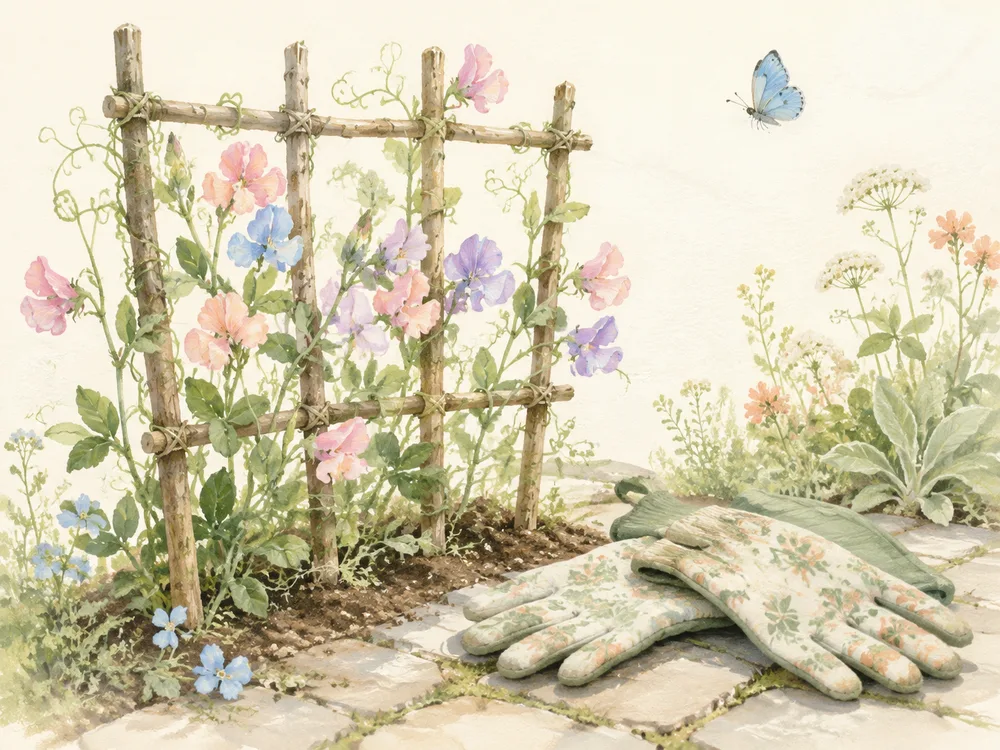
The sweet peas are climbing the wooden slats, and there's still a stretch of trellis left undone. Someone at the table picks up the twine, someone else goes to fill a jug — today you don't need to fix the whole garden in one go. This version puts working with your hands, doing it with someone, and having a plan beforehand all together, and it wants to try something out with you: if you're going to work on something with someone, can you say up front how big a piece you're taking on, so you don't find out halfway through that you'd each agreed to something different? This is a garden story, not a claim about how good you are at managing things in real life.
Instead of just saying "let's tidy up together," pick one small piece that has a clear end, then ask how the other person wants to be involved. Someone's happy to carry things, someone else just wants to sit and sort seeds — both can be known before you start. The point of planning together is cutting down on guessing, not tying everyone's hands to the same set of steps. If it's really just one small task, saying where it stops can help more than a full list does.
Halfway through, someone might want to rest, and that means the division of labor needs another look. You can ask what they're still up for, instead of treating silence as an automatic yes to keep going. One more empty slot on the trellis doesn't erase what's already been done. Naming the option to rest or step back is what lets the earlier yes stay a real yes, and lets whoever's left know how much is actually still theirs to redistribute.
If the person next to you goes quiet, you don't have to jump straight to guessing they're upset or checked out. Just ask, "Want to take a break, or switch to something else?" — that gets you something more useful than a guess. You can also say you're tired first; you don't have to wait to be the last one still working. What this story wants to point out is that things going smoothly and everyone feeling okay aren't the same thing — but one question can make the difference a lot clearer.
Pick something small you already planned to do with someone. Say the point of it and when it ends, then each take a part. It can be cooking one meal together, or clearing a small shared table. Leave one chance partway through to reshuffle, and afterward each say one thing you'd want to keep doing this way. You don't need to invent a task just for this — and you don't need to drag anyone into a trial run of teamwork. Both people genuinely wanting to do it is the actual condition for starting.
The tools go back on the rack, and whatever's unfinished stays that way for now. Thinking back on today — was it more useful to know exactly where things stood, or to be able to change the plan together? Take the one that helped and leave the rest behind. This version of the garden doesn't hand you a leader role. It just leaves one question standing: how do you keep things moving while keeping everyone's actual willingness in the room? The answer can be small — it can start with one more question before the next time.
This is just a story pieced together from the six pictures you picked — it's not a psychological test, it doesn't diagnose anything, and it can't predict your future. Take it as a small nudge and a little fun.
EXPLORE / 08
Every outcome has a story. Explore another perspective and see what resonates.
Currently reading The Trellis List Garden
Browsing opens result articles. It does not retake the quiz or recalculate a score.